Showing posts with label Male Gaze. Show all posts

Monday, 18 December 2017

SLASHER CONVENTIONS: 4 Theory's

Propp's 7 recurring character types:

The villain - struggles against the hero
The donor - prepares the hero or gives the hero some magical object
The helper - helps the hero in the quest
The princess/prize - the hero journey is often ended when he marries the princess 
The dispatcher - character who makes the lack known and sends the hero off
The hero - reacts to the donor, saves the day, weds the princess
False hero - takes credit for the heros actions and tries to marry the princess

Star Wars example:

The villain - Darth vader
The donor - Obi-Wan Kenobi
The helper - Han Solo
The princess - Princess Leia
The dispatcher - R2D2
The hero - Luke Skywalker
False hero - Lando

The Gant rule:

Box office analyst Charles Gant has argued that a typical box office hit (a success in both the UK and US markets) will make ten times as much in the US ($) as in the UK (£). A great example of this is that Maze runner made £4million in the UK and $40 million in the U.S.

Stuart Hall:

Stuart Hall analysed the role of audience positioning in the interpretation of media texts in different social groups, he came up with a model suggesting three ways in which we may read media texts:
Dominant reading (Preferred reading): The reader fully accepts the preferred reading and understands it in the way the creator desired
The negotiated reading: The reader partly believes and accepts the preferred reading
The oppositional reading: The readers social position places them in an oppositional relation to the preferred reading.


Male/Female gaze:

The female gaze is a feminist film theoretical term representing the gaze of the female viewer. It is a response to feminist film theorist Laura Mulvey's term, "the male gaze," Male gaze theory utilises cinematography and editing to objectify and represent the female in a way that would appeal to the male audience, this is done by accentuating parts of the body through camera angles and framing.

Todorov's model of narrative structure:

Traditionally narrative structures follow an order of events:
1. The narrative starts with an equilibrium
2. An action or character disrupts the equilibrium
3. A quest to restore the equilibrium begins
4. The narrative continues to climax
5. Resolution occurs and equilibrium is restored

How we will used this theory:

1. Couple is in bed, relaxed as normal
2. Santa appears on TV, scaring Tiffany and disrupts the equilibrium
3. The couple head to the garage to find santa
4. The couple arrive at the garage and get attacked
5. Michael is killed

Auteur Theory:

Auteur theory is when the director behind the movie is credited as the main creative force behind the movie, this is a more simplistic definition of the theory but can be seen widely in the industry. A stricter definition is when the director has a distinctive style and approaches social realist subjects whilst being credited for it.

Levi-Strauss

Strauss believed the way we interpret words depends not so much on the meaning but our understanding of the different/opposite of the word, such as protagonist and antagonist or hero and villain. Possibly the most common example of this in a slasher movie is the final girl vs scream queen roles.

Barthes:

Narrative enigma is the use of withholding information from the viewer whilst giving just enough to make the audience watch on to find out what is happening, this can be done through many ways:
  • Suspenseful Music
    • Creates suspense as the viewer doesn't know what is going to happen next but knows something will happen
  • Camera angles that don't show faces
    • CU of body parts
    • Shots from behind
    • Over the shoulder shots
  • Witholding enough information to stop anchorage

How we will used this theory:

  1. Extreme long shots of house 
  2. Close ups of couple getting dressed that don't show the face through the use of narrative enigma
  3. Suspenseful music that builds up as the attack approaches

Thursday, 14 December 2017

JC SLASHER CONVENTIONS Final Girl

"The final girl is a trope in horror films (particularly slasher films). It refers to the last woman alive to confront the killer, ostensibly the one left to tell the story. The final girl has been observed in many films, including The Texas Chain Saw Massacre, Halloween, Alien, Friday the 13th, A Nightmare on Elm Street, Scream." - Wiki

Here are some examples of Final Girls in Slasher movies:

...
Scream - Sidney Prescott
...

...
In this clip we see Sidney Prescott fighting back, she is clearly a Final Girl and follows many of the key conventions, for example, she is tough, resourceful, intelligent and survives till the end due to her fighting back.

Halloween H20: 20 years later- Laurie Strode
...

...
Laurie Strode is another very clear final girl example and is a key archetype to the final girl conventions, she is a brunette, not sexually active, an introvert, tough, resourceful and uses her intelligence to survive.

Scary Movie (deconstruction = postmodernism) - Cindy Campbell
...

...
Scary Movie is a great example of a final girl character as it is a post-modern deconstruction of many movies, in the clip it is a deconstruction of Scream. In scary movie, the characters roles are amplified and shown more intensely, this means that Cindy Campbell's role as a final girl is amplified and shows her to be extra resourceful, tough and a fighter all key parts of a final girl role


Carole J Clover:

The Final Girl Theory was first made famous by Carol J Clover in the essay "her body, Himself: Gender in the slasher film" (1987), in this essay she stated that Slasher movies presented woman in a way that gives a very clear picture of the sexual attitudes of men towards woman at the time. Clovers theory lay in the reversal of the male role and scream queen role in which the final girl defeats the killer instead of being the first to die.


The Archetype:

...
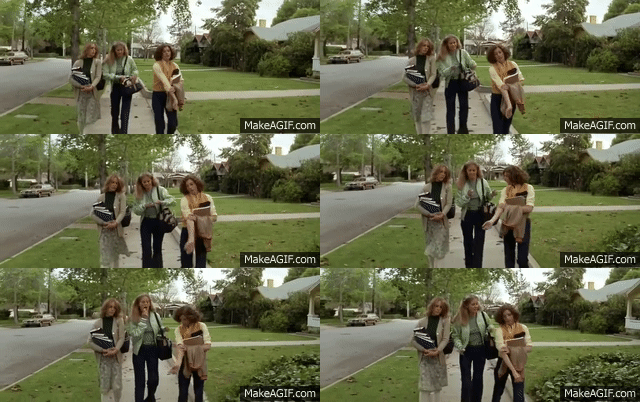
Halloween 1978 Creepy After School Walk Home (Steadicam shot and original Mono sound)


...

Laurie strode is the key archetype for a final girl, as can be seen here (girl on the left with books) she is nerdy, intelligent and in this scene it is made clear she does not have a boyfriend and is not sexually active. In this scene she she also says that she forgot her book at school to which her friends mock her for. Her friends are also smoking and talking about plans with their boyfriends, Laurie does not smoke or say she has plans which enforces her role as a Final Girl.
...
Image result for laurie strode clothes

...
The costume of Laurie Strode wears helps to signify her role, this is because it is very conservative, unrevealing and stereotypically worn by someone that is nerdy.

Other Examples of Final Girls:


Here are some other examples of Final girls in a variety of slasher movies, all of these reflect parts of the Final Girl convention.

Friday 13th - Alice hardy
...
Image result for alice hardy
...
Psycho - Lila Loomis
...


...
Nightmare on Elm street - Nancy Thompson
...


...
Texas Chainsaw Massacre - Sally Hardesty
...


...
Many of these characters reflect the same conventions of the final girl, they all dress conservatively, they are intelligent and tough and they either die lateen the movie or survive, juxtaposing the traditional scream queen role.


Possible Influences 

  • Will have conservative clothikng 
  • She will be seen as a smart/intelligent character
  • Will be the last character to survive (along side scream queen in which we have challanged the convetions) 

SLASHER CONVENTIONS Scream Queen

The term scream queen is used when referring to a young, attractive, sexually active and rebellious women. The convention is that the scream queen will be the first character to be killed. A scream queen is usually blonde, busty and seen as 'dumb'.

A brilliant example of a scream queen is Drew Decker in the film Scary Movie(Keenen Ivory Wayans)(2000). This film has really taken every single convention of a scream queen and put it into one character. This convention relates largely to the male gaze theory as it is a women who is being objectified.

Sometimes the films also challenge the conventions and create a 'Scream King' which is basically a male version of a scream queen. We have done this in our own film opening.

Here are some few examples of scream queens in slasher movies.                                                                                                                                

Scream (Wes Craven)(1996) - Casey Becker
...

...
In this clip Casey Becker is at home on the phone and the killer is on the other side telling her what to do and asking her questions. The killer then appears and she is chased throughout the house.  To her parents shocks she is killed at the end and hung from a tree.

Scary Movie (Keenen Ivory Wayans)(2000) - Drew Decker
...

...
This is one of the first scenes in the film. It is a recreation of Casey Becker getting killed in Scream. With the same scenario of her being chased throughout the house. Drew Decker is a great example of a scream queen, there are shots where it shows how 'dumb' she is. For example, a sign saying saftey pointing to the left and a sign saying death posting to the right. Drew decided to go right where the sign says death. All this links into the fact that Scary Movie is a post-modern deconstruction of the slasher genre.

Halloween (John Carpenter)(1978) - Annie Brackett
...

...

Black X/Cmas - Barbra Cord
Psycho - Marion Crane
Cherry Falls - Jody Marken
NoES - Tina Grey
Cry_Wolf - Becky
All the Boys Love Mandy Lane - (Scream King) Dylan
Babysitter Wanted - Rebecca Miller
TCM - Pam

Possible Influences 


  • We will create the young and rebellious character 
  • Will have mise - en -scene to suggest she is sexually active
  • Will be seen as "dumb" 
  • She won't have the blonde hair